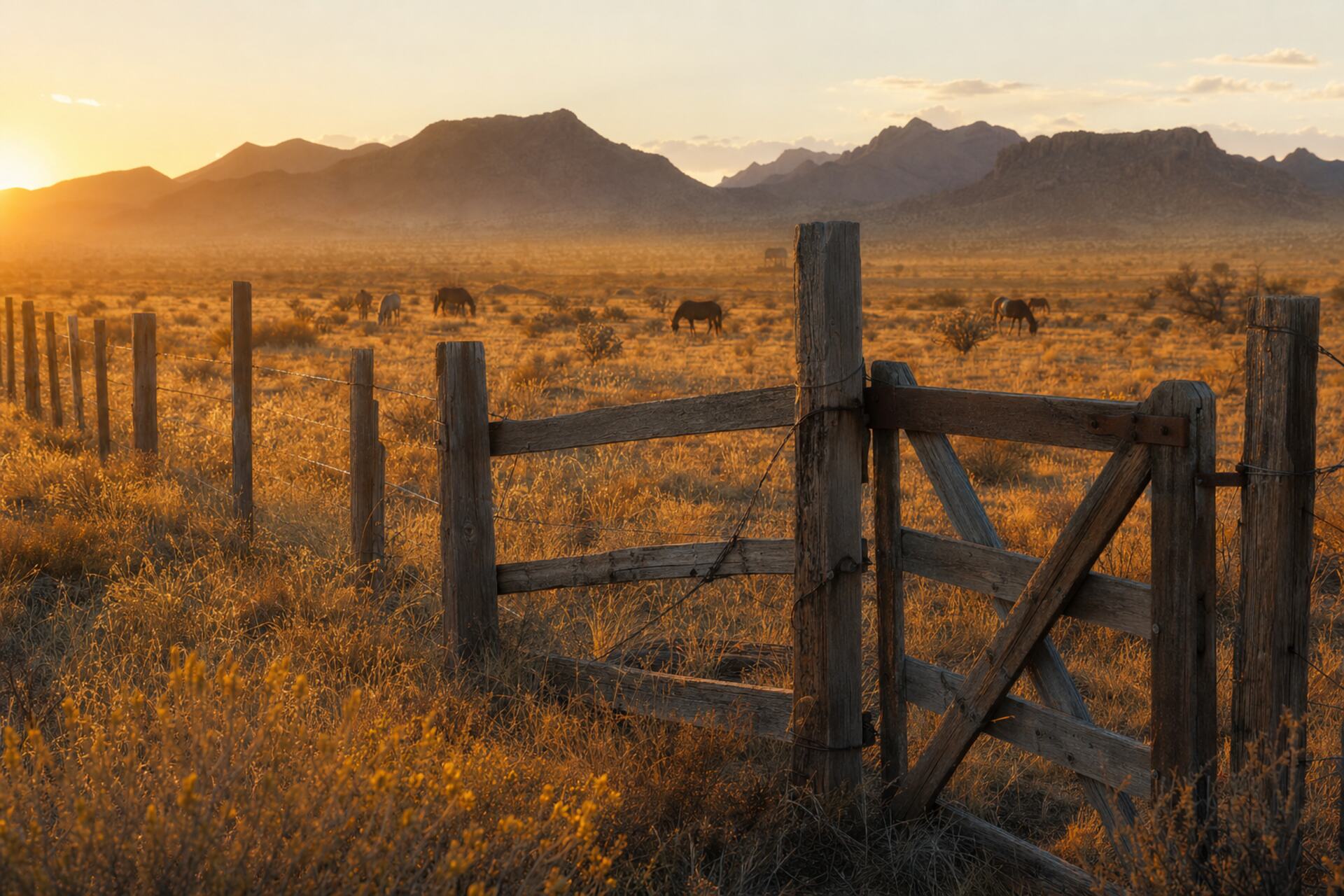
Wooden fence line crossing open Arizona pasture at golden hour with horses grazing in the distance

The guide

Buying with animals in Yavapai County

Zoning, wells, septic, fencing, easements, flood zones and trailer access — the things that decide whether a property actually works for dogs, chickens, horses and land. Written to be useful, not to fill a page.

Dog friendly

Fenced yards, HOA restrictions, nearby trails — and the difference between a fence and a dog fence.

The fence is the whole ballgame

Listings say "fenced yard" for everything from a six-foot block wall to three strands of sagging barbed wire that were installed for cattle in 1978. Barbed wire and field fence are not dog fence. Neither is split rail. Walk the perimeter yourself and look for gaps at drainages, washouts under the bottom rail, and gates that don't latch under pressure.

  • Height and diggers. Most yards in the Prescott area top out at four feet. If you have a jumper or a digger, budget for height plus a buried apron or a concrete/gravel footer at the fence line.
  • Material vs. climate. Wood dries out and splits fast in Arizona sun. Welded wire on steel posts, no-climb horse fence and view fence all hold up better and are easier to repair.
  • Wildlife. Coyotes, bobcats, javelina and the occasional mountain lion are normal here, not exotic. A yard that stops your dog from getting out may still not stop something from getting in — that's why a lot of local owners add a covered "night pen" close to the house.
  • Heat and gravel. Decomposed granite is the default yard surface and it gets hot. Shade structures and a shaded water source matter more than square footage.

HOAs and dogs

Plenty of Prescott-area subdivisions are governed by CC&Rs that limit the number of dogs, ban outdoor kennels or runs, prohibit certain fence types and heights, and enforce nuisance-barking rules. None of that is visible from the street. What to verify: get the full CC&Rs and current rules and regulations during your inspection period, not the two-page summary, and read the animal, fencing and outbuilding sections before your contingency expires.

Trails, which is why people move here

The Prescott Circle Trail, the Peavine and Iron King rail-trails, Watson and Willow Lake, Thumb Butte and the Constellation trails are all dog-country. Leash rules vary by managing agency — City of Prescott parks, Yavapai County and the Prescott National Forest each have their own. Proximity to a trailhead is a real and durable value factor; ask me which neighborhoods actually have walk-out access versus a ten-minute drive.

Dog in a fenced Arizona high desert backyard at golden hour

Want chickens?

Zoning, HOA rules and acreage requirements. Three separate rulebooks, and all three have to say yes.

Three separate rulebooks, and all three have to say yes

Whether you can keep hens depends on the jurisdiction (city vs. town vs. unincorporated county), the zoning designation of that specific parcel, and any private CC&Rs recorded against it. A private HOA can prohibit chickens even where zoning clearly allows them. That trips people up constantly.

  • City of Prescott. Incorporated city limits, and the most restrictive of the local options. Keeping poultry is regulated by zoning district, and standards commonly address lot size, the number of birds, roosters, and how far a coop must sit from property lines and neighboring dwellings. Verify with the City of Prescott Community Development / planning and zoning counter for the exact parcel.
  • Town of Prescott Valley. Its own municipal code, separate from Prescott's. Some residential districts accommodate a limited number of hens with setback and enclosure requirements; others don't. Verify with Prescott Valley's planning department.
  • Town of Chino Valley. Historically the most agriculture-friendly of the three incorporated communities, with residential-agricultural districts where poultry and other livestock are common. Standards still scale with lot size. Verify with the Chino Valley planning department.
  • Unincorporated Yavapai County. Where most true acreage sits. County zoning districts (residential, RCU-style rural, agricultural) differ widely on livestock, and allowances commonly scale with parcel size. Verify with Yavapai County Development Services and confirm the parcel's zoning by APN.
How to actually verify it

Get the parcel number (APN) off the listing, look it up on the Yavapai County Assessor's parcel viewer to confirm the parcel's size and jurisdiction, then call the planning counter for that jurisdiction and ask a specific question: "For APN ____, what zoning district is this, and what poultry or livestock does that district allow at this lot size?" Get the answer in writing or by email if it's going to change your offer. Then separately confirm there are no recorded CC&Rs limiting animals — your title commitment lists them.

Practical coop realities out here

Predator pressure is heavy: coyotes, bobcats, raccoons, ringtails, skunks, snakes, and hawks and owls from above. A fully enclosed run with a buried apron and a hardware-cloth roof is standard, not paranoid. Chicken wire keeps chickens in; hardware cloth keeps predators out. Also plan for winter — Prescott and Chino Valley get real freezes and snow, so water heating and draft-free (but ventilated) coops matter.

Roosters are the most commonly restricted item even where hens are allowed, usually under noise or nuisance provisions. If you want to hatch, check that specifically.

Backyard hens beside a small wooden coop on a Yavapai County property

Horse property

Water, easements, arena potential and trailer access — in that order of importance.

Water first. Everything else second.

A horse drinks roughly 5–10 gallons a day, more in summer work. Before you consider whether the barn is pretty, find out how water gets to it.

  • Private well. Ask for the well registration number and pull the record from the Arizona Department of Water Resources well registry — it shows depth, casing and the driller's reported yield. Then get a current flow test as a condition of your offer. A well that produced well in 1994 is not a promise about today.
  • Shared well. Extremely common in Yavapai County and a genuine risk if handled casually. There should be a recorded shared-well agreement covering cost sharing, maintenance, repair decisions, allocation and what happens when one party wants to add livestock or irrigation. If there's no recorded agreement, that's a problem to solve before closing, not after.
  • Hauled water and cistern. Workable and normal on some parcels. Price the recurring cost and confirm the delivery truck can physically reach the tank year-round.
  • Frost protection. Freeze-proof hydrants at the barn and pasture. Retrofitting waterlines in decomposed granite is not cheap.

Easements and access

On rural parcels the deeded access is often across someone else's land. You want a recorded easement with a defined width and location, not "we've always used that road." Read the title commitment's Schedule B exceptions with me — that's where easements, rights-of-way, utility corridors and old mining or grazing rights show up. Also check whether the road is county-maintained, maintained by a road association with dues, or maintained by nobody, which means you and the neighbors, forever.

Arena potential and turnout

Look at slope, drainage and native footing before you dream about a 100x200. Where does monsoon runoff go? Is there enough flat area to grade an arena without an engineered retaining wall? Is the soil expansive clay or good sandy granite? Also confirm the zoning district's rules on the number of animals per acre and on setbacks for barns, stalls, manure storage and covered arenas — those vary by jurisdiction and district, and permits for large covered structures are their own process.

Trailer access — drive it, don't assume it

Bring a truck, ideally with the trailer. Check the driveway grade, the turning radius at the top, overhead tree clearance, the width of gates and cattle guards, culvert and bridge weight limits, and whether the last mile is a dirt road that turns to grease in a monsoon. Then ask: can a vet or farrier get in, and can a hay delivery or a fire truck?

Horses in a corral beside a barn on Arizona acreage at sunset

Land

Wells, septic, flood zones and building restrictions. What “buildable” actually means out here.

Wells

Buying raw land usually means drilling. Depth is highly variable across Yavapai County — parcels a mile apart can be radically different — and cost scales with depth plus casing, pump, pressure tank, electrical and permitting. Talk to a local driller about wells recently completed near that parcel before you assume a number. Also confirm whether the parcel sits inside an Active Management Area or an Irrigation Non-Expansion Area, since that affects what kind of well you can drill and how it's regulated. Arizona Department of Water Resources maintains the well registry and the maps.

Septic

No sewer means an on-site wastewater system, permitted through Yavapai County Environmental Services (under Arizona Department of Environmental Quality rules). A percolation/site evaluation determines what system the soil will accept — a conventional leach field is the cheap outcome; poor perc or shallow bedrock can push you to an engineered alternative system at multiples of the cost. On resale properties, Arizona requires a transfer-of-ownership inspection of the on-site system before the deed transfers; who pays and who fixes is negotiable, so put it in the contract deliberately.

Flood zones and drainage

Check the FEMA flood map for the parcel and, just as importantly, walk it and look for evidence of where water goes: cut banks, debris lines, sand deposits, washes. Monsoon runoff in the high desert is fast and destructive, and a parcel can drain badly without ever appearing on a flood map. If any part of the buildable area is in a special flood hazard area, expect floodplain permitting requirements and lender-required flood insurance.

Building restrictions and what "buildable" really means

  • Zoning and minimum lot size for the district, plus setbacks and maximum lot coverage.
  • Legal access — a recorded easement or frontage on a public road. Landlocked parcels are cheap for a reason.
  • Utilities — get a written line-extension cost from APS or the local co-op. Running power a half mile can cost more than the land.
  • Driveway and grading permits, culverts, and any required engineered drainage plan.
  • Wildfire — defensible space and ignition-resistant construction expectations, plus how the parcel affects insurability. Ask an insurance agent before you close, not after.
  • CC&Rs, deed restrictions and any subdivision plat notes, which can prohibit manufactured homes, RV living during construction, outbuildings, or livestock.
  • Split history. Arizona has rules around lot splits and unapproved "wildcat" subdivisions; confirm the parcel is a legally created lot.
Open land parcel with a dirt two-track road in Chino Valley, Arizona

Lifestyle

National Forest access, hunting nearby, ATV roads — and the fine print on all three.

National Forest and public-land access

The Prescott National Forest wraps around this area, and there's substantial Arizona State Trust land and BLM ground as well. Backing to public land is genuinely valuable — no future neighbor, ride or hike out your gate — but understand the details: State Trust land requires an individual recreational permit for hiking, horseback riding and similar use, and it can be leased for grazing or sold. Forest access points and gates can also change. Confirm exactly what your parcel borders on the plat and county GIS rather than trusting the listing photo caption.

Hunting and shooting

Yavapai County covers multiple Arizona Game and Fish hunt units; elk, deer, javelina, antelope and quail are all in play depending on unit and draw. If you intend to hunt near home, check the unit boundaries and the seasons rather than the marketing copy. Discharging a firearm is also regulated separately from hunting — rules differ inside city or town limits versus unincorporated county, and near occupied structures. If target shooting on your own land matters to you, verify it for that specific parcel before you buy.

ATV and OHV country

There's a large network of forest roads and OHV routes through this region, including access from many rural subdivisions. Machines need to be OHV-registered and street-legal to travel on public roads, some routes are seasonally closed, and forest roads can be gated for fire restrictions or wildlife closures. Also check whether your subdivision's CC&Rs restrict OHV use on interior roads — several do.

The rest of what living here is actually like

  • Elevation and four real seasons. Prescott sits around 5,300 ft, Prescott Valley a little lower, Chino Valley in the same range. Snow happens. Roads at higher elevation and on north slopes hold ice.
  • Fire. Wildfire risk is real and it drives insurance availability and cost. Defensible space is maintenance, not a one-time chore.
  • Monsoon. July through September, hard fast rain, washes that run, dirt roads that rut.
  • Services. Trash, internet options, school district boundaries, ambulance and fire-district coverage all vary parcel to parcel out in the county. Fire-district status in particular can change your insurance premium meaningfully.
Forest road winding through ponderosa pines in the Prescott National Forest

Buying or selling

How I work with buyers, sellers and investors throughout the Prescott area.

Buyers

My process is boring on purpose: figure out what your animals and your life actually require, translate that into search criteria that a computer can run, then verify the disqualifying facts — zoning, water, access, septic, CC&Rs, flood — before you get emotionally attached. Inspection period is short. We use it deliberately, with the right specialists lined up: well flow test, septic transfer inspection, and a general inspector who understands rural systems.

Sellers

If you own acreage, horse property, or a home with real animal infrastructure, the generic listing approach undersells you. Your buyer isn't looking for square footage; they're looking for the barn, the fencing, the well yield, the flat spot for an arena, the fact that a 40-foot trailer can turn around. Those facts have to be documented, photographed and marketed on purpose. That's what I do — and it's also why I market to animal owners directly instead of hoping the right person wanders in.

Investors

Land splits, rentals, and hold strategies across Prescott, Prescott Valley, Chino Valley, Dewey-Humboldt, Paulden and the surrounding communities. Same rule as always: I'll tell you when the numbers don't work.

One honest disclaimer

Everything on this page is general education to help you ask better questions. Ordinances, zoning districts, HOA documents and agency rules change, and they apply parcel by parcel. Nothing here is legal advice or a substitute for confirming the specifics with the city, town or county that governs the property — which is exactly what I'll help you do before you're under contract.

Golden hour view over Prescott Valley, Arizona with mountains beyond